
CedrusMed EDI
Behind every healthcare claim is not just a transaction. There is a professional who delivered care, documented a service, followed a client through a complex system, and carried the responsibility of getting the details right.
In behavioral health, that professional may be a case manager, therapist, psychiatrist, community mental health specialist, billing coordinator, or agency leader. Their work is deeply human. Yet too often, the technology surrounding that work has remained fragmented, repetitive, and unnecessarily manual.
For many behavioral health organizations, the clinical record and the billing process still operate as separate workflows. A specialist documents a service in one part of the process. A billing team may then need to review, organize, validate, or re-enter information elsewhere. Member IDs, procedure codes, diagnosis codes, provider identifiers, insurance details, and service dates must often be checked across multiple points in the workflow.
The issue is not a lack of effort. It is a workflow problem.
Manual billing processes can require skilled professionals to spend time repeating or verifying information that has already been captured. Every duplicate entry or disconnected handoff can create another opportunity for an error, delay, or lack of visibility. In a field where staff time is already stretched thin, that administrative weight matters.
CedrusMED was built around a practical principle: information documented in the clinical record should be able to support the electronic claims workflow more efficiently, while keeping professional judgment and organizational responsibility where they belong — with the agency and its authorized staff.
A Technical Solution to a Human Workflow Challenge
CedrusMED is an Electronic Health Record platform designed for behavioral health, Targeted Case Management, and Community Mental Health programs. Its Electronic Claims module uses Electronic Data Interchange, or EDI, to help connect clinical documentation with the structured billing workflow that follows.
The goal is not to replace the judgment of clinicians, billing teams, compliance personnel, or agency leaders. Those professionals remain responsible for documentation, coding, billing decisions, payer requirements, and compliance with applicable laws, contracts, and policies.
The role of the software is more focused: to help organize the process, reduce repetitive manual steps where possible, improve visibility, and support a traceable workflow from documentation through claim reconciliation.
At the center of the CedrusMED Electronic Claims module is a four-stage workflow:
Generate. Correct. Transmit. Reconcile.
Together, these stages help agencies prepare claims from existing documentation, review claim information before submission, correct records when needed, transmit claims electronically through the agency’s clearinghouse, and reconcile payer responses when remittance information is returned.
1. Generate: Building Claims from Approved Documentation
The first step in the workflow is claim generation.
In CedrusMED, approved services can be assembled into structured electronic claims based on information available within the system. Claims may be organized by client, payer, member ID, provider, program, service week, and other required claim elements.
Before claims are generated, CedrusMED presents a read-only preview. This allows the billing team to review what the action is expected to do before confirming it. The preview can show which claims are new, which existing claims may be updated, and which services may require attention because of timing or missing information.
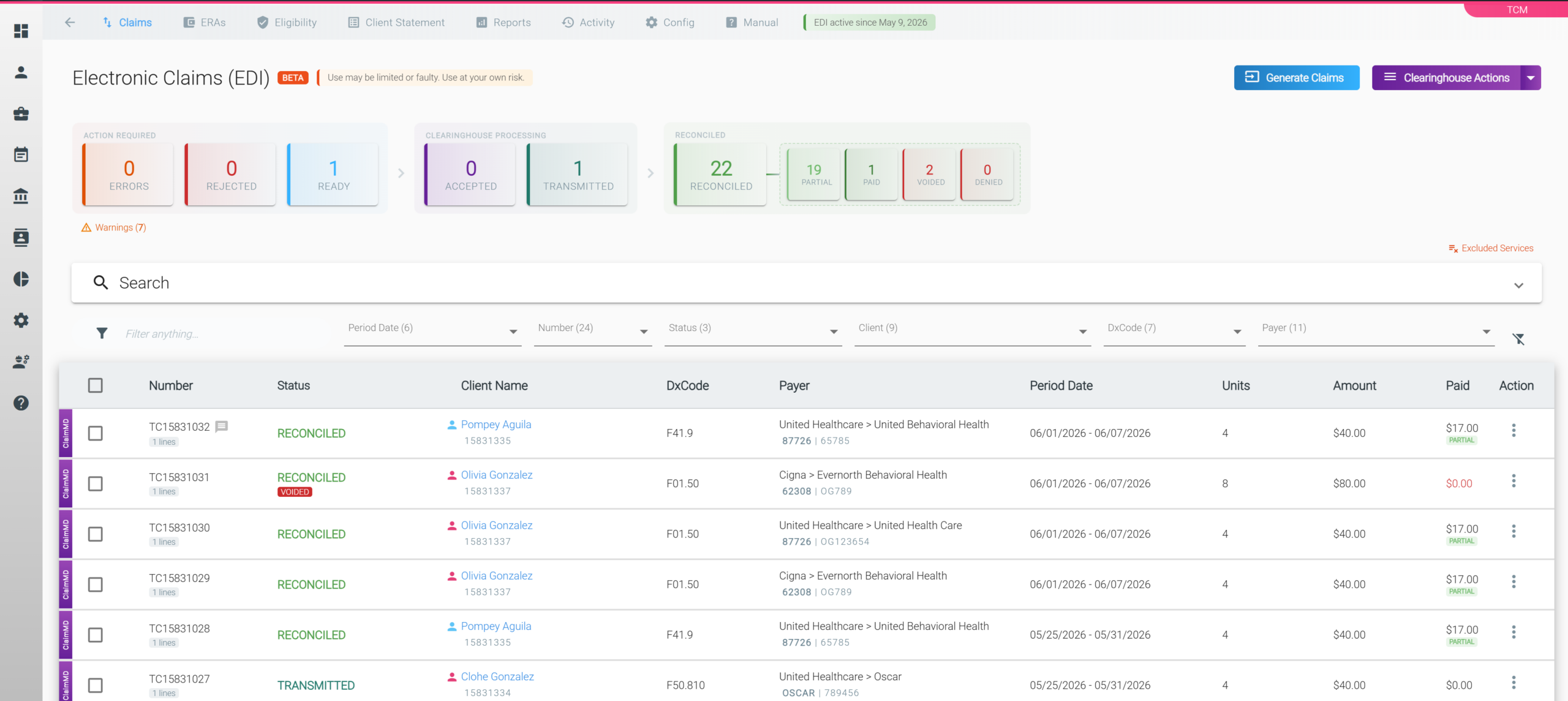
This matters because billing teams need visibility before action. A claim-generation process should not feel like a black box. Staff should be able to see what is being created, what may require review, and what information may be incomplete.
When required information is missing or incomplete, CedrusMED can display validation messages identifying the relevant issue, such as a missing member ID, diagnosis code, provider identifier, insurance detail, or other required field. The software surfaces the gap; the agency’s authorized staff decide how to resolve it.
That distinction is important. CedrusMED does not determine whether a service is billable, whether documentation is sufficient, whether a payer will accept a claim, or whether payment will be made. CedrusMED provides a workflow that helps authorized professionals prepare, review, and manage claim information using data provided and maintained by the agency.
2. Correct: Managing Revisions Within the Claims Workflow
Billing is rarely a single-pass process. Information may change. A diagnosis may be updated. A procedure code may require review. Insurance details may be corrected. A claim that was already generated may need to be rebuilt, updated, or submitted as a corrected claim.
In disconnected environments, this can become difficult to track. Staff may need to compare information across portals, spreadsheets, clearinghouse screens, or separate billing tools to understand what changed and what needs attention.
CedrusMED is designed to keep corrections within the same claims workflow.
When underlying clinical or billing information changes after a claim has been created, the system can help identify that claim data may no longer align with the current record. The billing team can then review the relevant information before taking further action.
When a corrected claim must be submitted, CedrusMED can help structure the correction in a standards-based manner and reference the original submission where appropriate. The software supports the technical workflow, while the agency’s professionals remain responsible for deciding whether a correction is appropriate and for ensuring that any corrected submission complies with applicable payer, contractual, legal, and regulatory requirements.
This approach reduces fragmentation. Instead of treating corrections as an external workaround, the correction process can remain part of the same auditable workflow.
3. Transmit: Supporting Electronic Submission Through the Clearinghouse
Once claims are reviewed and approved by the agency’s billing team, they can be transmitted electronically through the agency’s clearinghouse.
This can reduce the need for paper-based handling, manual file transfers, or disconnected re-entry into separate systems, depending on the agency’s configuration and clearinghouse connectivity.
From the Claims List, staff can follow each claim’s status as updates are available through the workflow. Claims may move through stages such as generated, submitted, accepted, transmitted to the payer, or otherwise updated based on information returned by the clearinghouse, payer, or related systems.
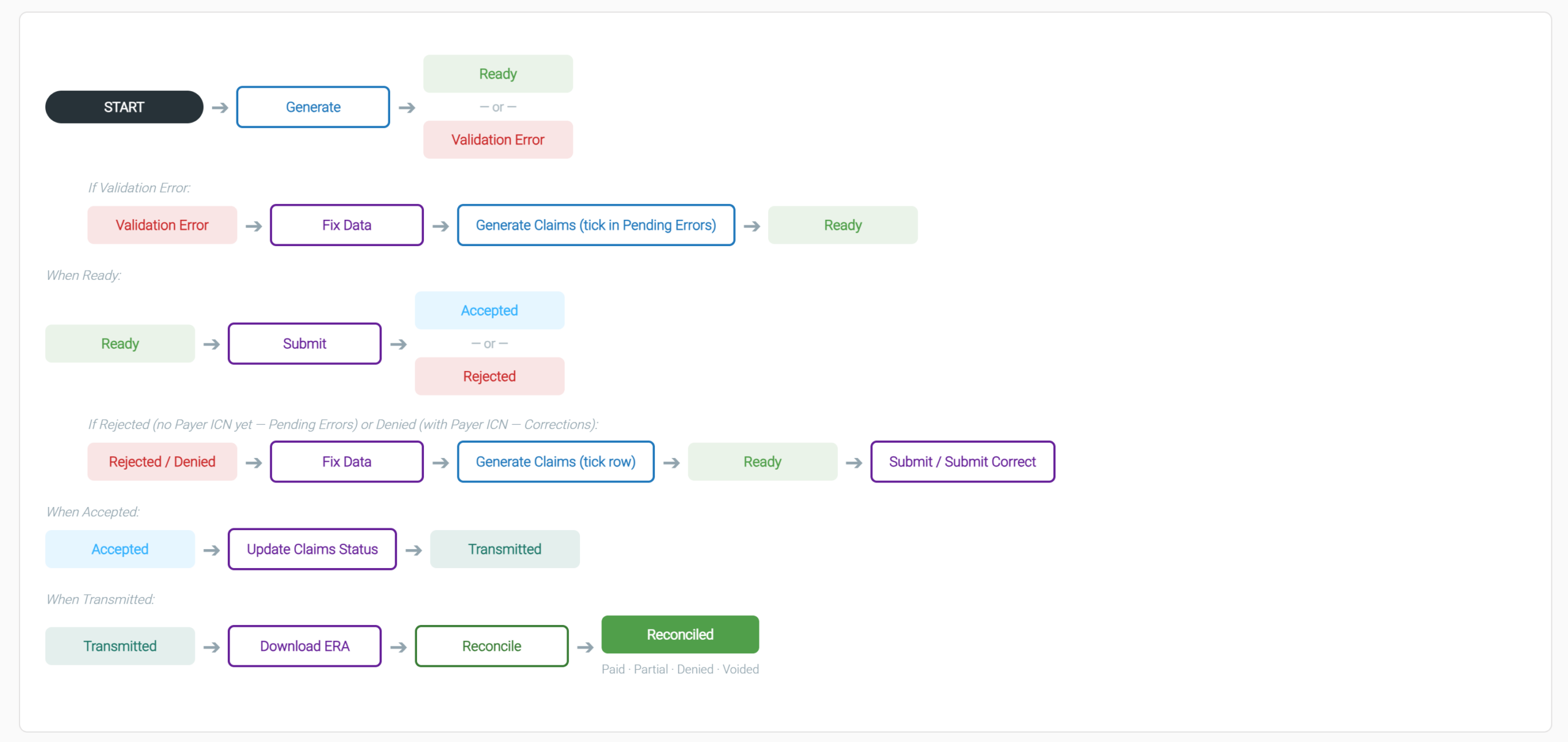
The value is not simply electronic transmission. The value is visibility.
A claim should not disappear once it leaves the agency’s internal workflow. Billing teams need to understand where it stands, what action has occurred, and whether additional review may be needed. By keeping claim activity organized in one place, CedrusMED helps agencies maintain a clearer operational view of their electronic claims process.
4. Reconcile: Connecting Remittance Information Back to the Original Claim
The final stage is reconciliation.
When payers return Electronic Remittance Advices, CedrusMED can retrieve and organize that information so it can be matched back to the originating claims and the services behind them. This helps billing teams review payer responses in relation to the original claim records and supporting documentation.
Without an integrated workflow, reconciliation often requires staff to compare information across disconnected systems. The clinical record may live in one place, the submitted claim in another, and the remittance information somewhere else. That separation can make it harder to understand what happened and what requires follow-up.
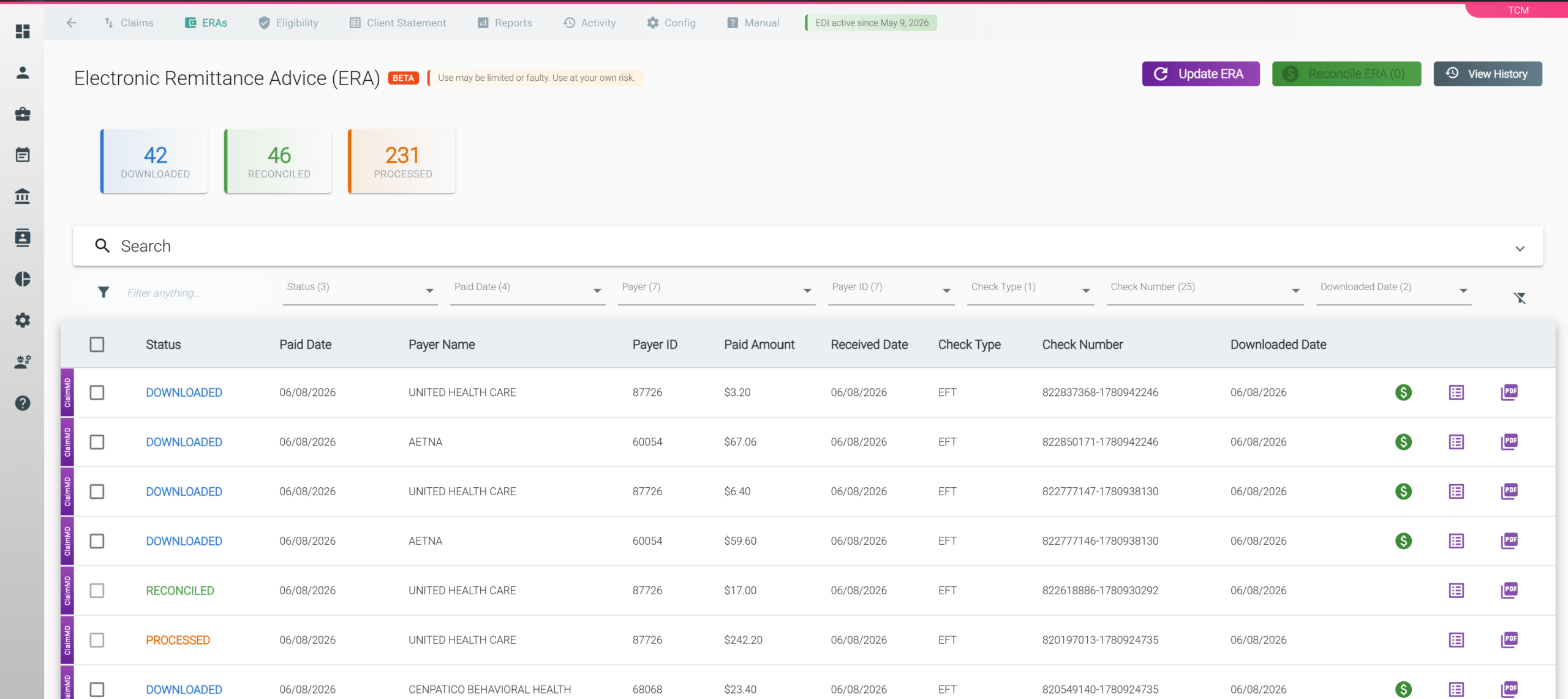
CedrusMED helps bring those elements into a more traceable structure. Remittance information can be connected back to the claim and the work that produced it, supporting the agency’s internal review and recordkeeping process.
CedrusMED does not guarantee payment, determine payer coverage, make medical-necessity decisions, or ensure that any claim will be approved. It supports the agency’s own review process by organizing claim and remittance information within the electronic claims workflow.
Designed Around the People Doing the Work
Technology in healthcare often fails when it is designed around systems instead of people. CedrusMED’s Electronic Claims module was designed around the professionals who carry the work forward every day.
For clinicians and case managers, the value is that documentation entered into the clinical record can help support the billing workflow without requiring unnecessary repetition.
For billing teams, the value is a structured process that helps them generate, review, correct, transmit, and reconcile claims from a single environment.
For agency leaders, the value is visibility. A unified claims workflow can make it easier to understand where claims stand, what actions have been taken, and where staff attention may be needed.
This is not automation for the sake of automation. It is workflow design in service of professional judgment.
The best healthcare technology does not remove responsibility from people. It reduces repetitive administrative work around them.
Trust, Auditability, and Data Integrity
Behavioral health data is among the most sensitive information in healthcare. Any platform supporting this work must treat privacy, data separation, access control, and traceability as foundational requirements.
CedrusMED is designed with an architecture and tenant-level data isolation controls to help keep each agency’s clients, records, and claims separated from other organizations on the platform.
The Electronic Claims workflow also supports audit logging for key actions, including claim generation, correction, transmission, and reconciliation activity. This helps agencies review what was done, when it was done, and by whom.
Data integrity indicators can further support the workflow by showing when clinical or billing information behind a claim has changed. Instead of allowing discrepancies to remain hidden, the system helps make them visible for staff review.
These capabilities are designed to support an agency’s own oversight. They do not replace the agency’s responsibility for clinical accuracy, billing accuracy, coding decisions, payer requirements, privacy obligations, security practices, or legal and regulatory compliance.
One Platform for TCM and CMHP Workflows
Behavioral health agencies often serve multiple programs with different documentation, provider, authorization, and billing requirements. CedrusMED is designed to support Targeted Case Management and Community Mental Health workflows within a unified platform, subject to each agency’s configuration, payer requirements, and applicable program rules.
This allows agencies operating across both service areas to work within a more consistent environment rather than relying entirely on disconnected tools. Each program can maintain its own logic and requirements while benefiting from a shared claims workflow.
The result is a more coherent operational structure for agencies managing complex behavioral health services.
Technology in Service of Care
The divide between clinical documentation and billing is often a limitation of fragmented technology and disconnected workflows.
CedrusMED’s Electronic Claims module helps bridge that divide by supporting a structured, transparent, four-stage EDI workflow: generate, correct, transmit, and reconcile.
The purpose is not merely to move claims electronically. The purpose is to respect the time of the people behind every claim.
Every claim begins with care delivered by a professional. Every note reflects time spent with a client. Every billing action depends on details that must be accurate, reviewed, and traceable.
CedrusMED exists to support that work by helping manage the repetitive, technical parts of the process more effectively, so behavioral health professionals and billing teams can spend less time on disconnected administrative steps and more time focused on the people they serve.
CedrusMED is technology in service of the specialists who care for others.
CedrusMED is a software platform that enables authorized professionals to record and manage clinical documentation and to prepare, review, transmit, and reconcile electronic claims using information provided and maintained by each organization and its workforce. CedrusMED does not provide medical, billing, coding, legal, financial, or compliance services, and does not determine medical necessity, insurance coverage, payer acceptance, reimbursement, or payment. CedrusMED does not guarantee claim approval, payment, denial reduction, faster reimbursement, revenue improvement, or compliance with payer, federal, state, contractual, or professional requirements. The accuracy, completeness, legitimacy, and appropriateness of all documentation, services, codes, claims, submissions, corrections, and compliance decisions remain the sole responsibility of each organization and its authorized professionals. Features, workflows, integrations, claim status information, and remittance information may depend on agency configuration, clearinghouse connectivity, payer rules, third-party systems, data availability, and applicable requirements. This article is informational only and is not legal, billing, coding, compliance, financial, medical, or professional advice. To learn more, visit cedrusmed.us.
About the Author: Eikel Inda